Your options for a home espresso machine start with a practical question: how much of each drink do you want to make yourself? Start with your preferred drinks and the routine you would accept, rather than choosing by price alone.
Origin Coffee explains that manual and semi-automatic machines often leave dosing, tamping and milk steaming to you. Fully automatic machines handle most brewing tasks with little intervention, but every espresso machine still needs routine cleaning. That makes preparation and upkeep separate buying decisions: decide how much help you want with each.
For a first setup, the Sage Bambino Plus is a useful starting point: The Guardian names it its preferred assisted option for beginners. Its automatic milk texturing allows unattended frothing, although it comes without a grinder. If your household wants more than espresso, The Guardian’s leading assisted choice, the Ninja Luxe Cafe Premier ES601, also makes filter coffee and iced coffee.
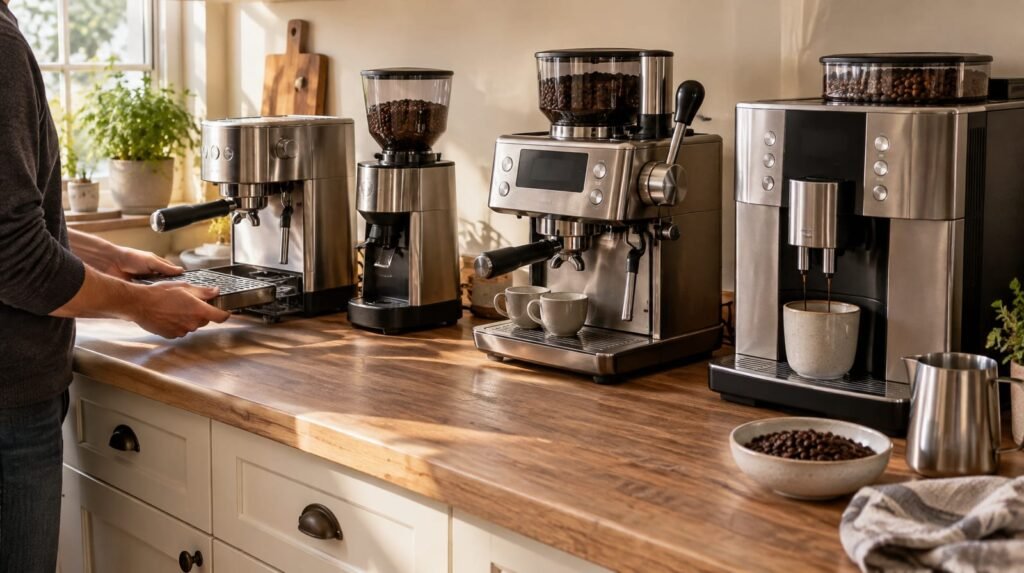
The comparison follows the choices that shape your routine, from grinding and preparing coffee to milk steaming and cleanup. You can weigh a separate-grinder setup against assisted machines, push-button preparation and capsules, then decide whether greater control is worth the extra involvement.
This article was produced with the help of AI and reviewed before publication.
In this article
- Compare home espresso machine options for your kitchen
- Choose how much of each drink you want to make
- Start with a separate grinder and a simpler machine
- Combine grinding, guidance and a wider drinks menu
- Choose push-button convenience or capsules
- Bring professional-style control into your home
- Check the full setup before you buy
- Turn your shortlist into a choice
Compare home espresso machine options for your kitchen
The Guardian lists the Stilosa EC230 at £89.99 from De’Longhi, ProCook at £199, Bambino Plus at £399 and Lelit Anna PL41TEM at £509.95. Origin Coffee lists the Sage Bambino at £329.95; check whether your chosen package includes a grinder. The Guardian confirms the other four have no grinder, so budget for one if you want to use fresh beans. For easier milk drinks, favour the Bambino Plus: The Guardian names it its best assisted machine for beginners and praises its automatic milk texturing.
Sasha Muller’s budget pick in The Guardian is the De’Longhi Stilosa EC230, supplied with unpressurised baskets. For preparation guidance, consider the Ninja Luxe Cafe Premier ES601: Muller rates its Barista Assist highest among the machines reviewed.
For extensive adjustment, usability and coffee quality, Muller favours the Sage Dual Boiler, listed by The Guardian at £1,059.95 from Origin Coffee. He advises allowing about £300 more for a grinder. Choose the Stilosa EC230 for the tightest machine budget, remembering that its £89.99 price excludes a grinder. The Premier ES601 includes a grinder, making it a combined setup rather than another machine-only purchase.
Choose how much of each drink you want to make
Choose by the work you want to keep: hands-on extraction, assisted preparation or convenient drink selection.
Control preparation yourself
Lever machines generate pressure through a hand-operated piston; semi-automatic machines use a pump, CoffeeBlog explains. That does not tell you how much grinding, dosing and tamping the machine leaves to you.
The La Pavoni Professional uses a manual lever and manual tamping, with no integrated grinder, according to Coffeeness. Choose it for hands-on involvement. Origin classifies the Sage Bambino as semi-automatic; CoffeeBlog confirms its milk steaming is manual.
Keep the portafilter but add assistance
The Sage Oracle Jet grinds, doses and tamps, but you still attach its portafilter and start extraction, The Telegraph explains. Its rinsing and purging are automatic, but wiping the steam wand remains your job. This suits you if puck preparation is the chore, rather than portafilter handling.
Let the machine handle more
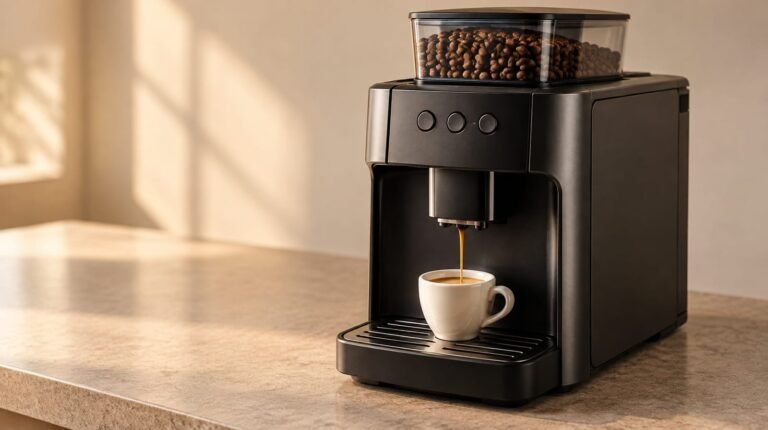
Coffeeness describes the Gaggia Accademia as super-automatic, with a grinder, grounds container and automatic or manual milk preparation. Prefer this style if you want beans without the assisted portafilter workflow.
The Telegraph describes the Nespresso Vertuo Creatista as restricted to Vertuo capsules, with barcode-directed brewing, automatic milk frothing and a used-capsule compartment to empty. Choose capsules if avoiding loose-ground preparation matters more than coffee-format flexibility.
If you want to keep preparing the coffee yourself, start by comparing machines that leave room in the budget for a separate grinder.
Start with a separate grinder and a simpler machine
Spend less on the machine
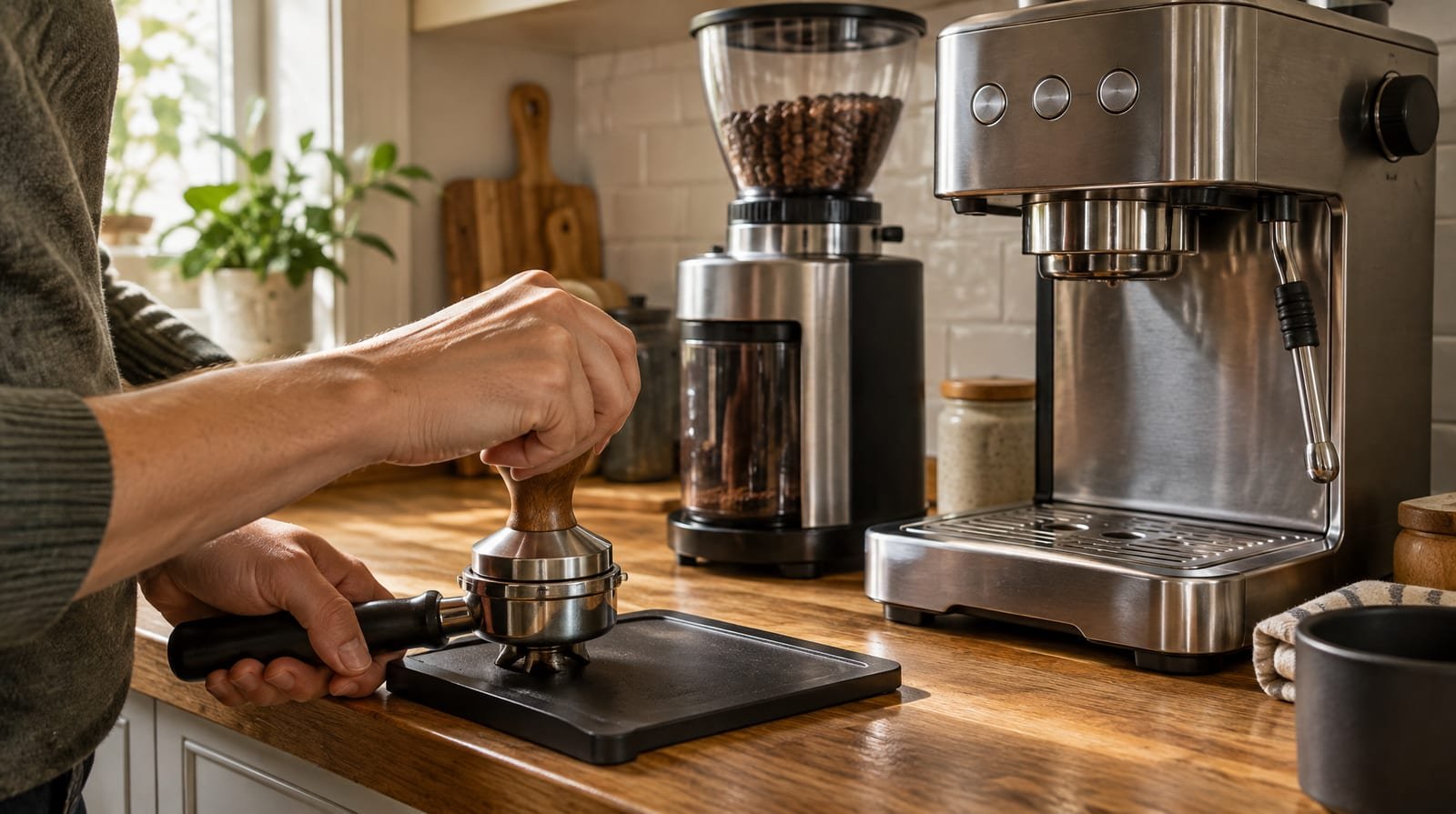
The Guardian prices the Stilosa EC230 at £89.99 from De’Longhi, without a grinder. Keep a grinder in your budget: Coffee Chronicler stresses sufficiently fine grinding and precise adjustment for dialling in espresso. Distinguish the EC230 from the EC235 and EC260, whose pressurised baskets suit pre-ground coffee, according to The Guardian.
Prioritise quick espresso or easier milk
Origin prices the Sage Bambino at £329.95; The Guardian prices the Bambino Plus at £399 from John Lewis. Coffeeblog’s Kev considers the Bambino better value for mainly black coffee, reporting identical espresso quality but slower steaming than the Plus. His recommendation favours the Plus for daily milk drinks, where speed and repeatability justify the premium.
Choose adjustable temperature
The Guardian prices ProCook at £199 from ProCook. Muller recommends its affordable temperature adjustment: brewing settings span 90–96°C in 2°C increments, but steaming disappoints him.
Muller’s leading manual choice, the Lelit Anna PL41TEM, costs £509.95 from Coffee Friend in The Guardian’s review. It regulates brewing and steaming temperatures with PID control, and he rates its performance excellent for the price. Choose it for greater temperature control, provided its manually filled boiler does not put you off. Neither Anna nor ProCook includes a grinder.
A separate-grinder setup is not the only route to hands-on espresso. Next, decide whether integrated grinding and preparation assistance would suit your routine better.
Combine grinding, guidance and a wider drinks menu
Build barista skills with assistance
For developing home-barista skills, favour the Sage Barista Express Impress. Coffeeblog’s Kev names it his best overall speciality-coffee option, balancing espresso quality with accessibility. Check its current retail price against the assisted alternatives before shortlisting it.
Its dosing and tamping assistance leaves milk steaming manual. Kev finds both the Express Impress and Sage Barista Pro more controllable than the Ninja Luxe Café Pro 701. Origin says the Barista Pro leaves tamping to you.
Make espresso and filter-style coffee
For espresso and longer coffees, favour the Ninja Luxe Café Pro 701. Kev’s all-rounder winner offers filter-style coffee, cold-brew-style drinks and single, double or quad espresso, without leading any individual category.
The Pro 701 has a lever-operated tamper and automatic or manual milk steaming. Kev reports variable automatic milk temperatures and frequent drip-tray emptying, especially with heavy steaming.
The Ninja Luxe Cafe Premier ES601 suits buyers wanting preparation guidance plus filter and iced coffee. The Guardian’s Sasha Muller rates its Barista Assist highest among the machines reviewed, while confirming that you can adjust grind size and brewing temperature. Choose the Ninja Luxe Café Pro 701 instead for its lever-operated tamper and cold-brew-style drinks, highlighted by Coffeeblog.
Pay more for automated preparation
Muller’s premium assisted winner is the Sage Oracle Jet; he finds its automatic dosing and tamping effective. The Guardian lists it at £1,699 from John Lewis. Its touchscreen provides animated guidance, and you can add custom recipes. Choose it when reducing puck preparation matters more than practising it.
Assistance suits you only if you still want the tasks it leaves behind. If those tasks are the sticking point, compare more automated preparation with capsules.
Choose push-button convenience or capsules
Automate preparation from beans
Serious Eats names the De’Longhi PrimaDonna Fully Automatic Espresso Machine its super-automatic winner and also recommends the Terra Kaffe TK-02. The Telegraph favours the Gaggia Magenta Plus among bean-to-cup machines with a milk frother, praising flavour and repeatability. It found five ceramic grind settings and a pre-ground option, but vibration shook a lightweight glass cup; heavier ceramic cups caused no problems. Check UK availability for the Serious Eats picks and the PrimaDonna’s UK grind and milk specifications; use Which?’s listings to compare UK bean-to-cup models and prices.
Choose capsules and compatible drinks
The Telegraph’s pod winner is the Nespresso Vertuo Creatista, praised for usability. Its three milk-temperature and texture choices add flexibility within the Vertuo-only limitation. Choose it if that capsule commitment suits you; the Telegraph notes capsules generally cost more than beans or ground coffee.
Check what still needs cleaning
The Telegraph says many fully automatic bean-to-cup machines have their own rinse and purge cycles, but automation still leaves cleaning work. The Gaggia Magenta Plus needs manual steam-wand purging after use. The Sage Oracle Jet rinses and purges automatically, but you still wipe its wand. With the Nespresso Vertuo Creatista, you empty the used-capsule compartment; connecting its app gives you descaling reminders.
If convenience is not your main priority, turn the comparison towards milk-drink workflow and extraction control.
Bring professional-style control into your home
Prepare several milk drinks
The Guardian reports that the Sage Dual Boiler has two stainless-steel boilers and a five-minute warm-up. For several milk drinks, favour a machine that lets you brew and steam together; confirm that capability in Sage’s own Dual Boiler specifications before buying.
Whole Latte Love recommends the dual-boiler ECM Synchronika II for latte-art steaming, with automatic pre-infusion, cleaning reminders and brewing readiness in 6.5 minutes. Bella Barista lists it at £2,679.00, making it the shortlist choice here for those controls and that warm-up. Whole Latte Love’s heat-exchanger pick, Bezzera LUCE, brews and steams together through a 2-litre copper boiler, with a 4-litre reservoir and a vibration pump. The LUCE cannot be plumbed in, so shortlist it for reservoir use and check its UK price before comparing costs.
Choose greater extraction control
For profiling enthusiasts, CoffeeGeek’s Mark Prince names the Lelit Bianca V3 an all-time best after weighing profiling, supplied accessories and ownership factors. It offers two programmed pressure-adjustment modes and one manual mode. Bella Barista lists the dual-boiler V3 from £1,979.00, against a regular price of £2,199.95. Check the retailer’s current price and warranty length before buying.
For a less profiling-focused setup, Coffeeblog says the Sage Dual Boiler lets you adjust pre-infusion duration and pump power separately. That separate adjustment suits owners who want to experiment without full profiling.
Prioritise Italian manufacture
Coffeeblog’s Kev names the Italian-made Gaggia Classic Pro E24 his under-£500 winner for construction, espresso potential and modification options. Clumsy Goat lists the Gaggia Classic E24 Evo Pro at £549.00. Coffee Chronicler advises against the 2024 EVO Pro update because of reported boiler-coating leaching concerns. Check which Classic version the retailer sells and which version its price applies to, rather than treating them as interchangeable.
The Lelit MaraX is another Italian-made option, according to Origin Coffee, with electronic coffee- and steam-temperature regulation. Origin lists a 24-minute warm-up, but treat that as a retailer’s figure rather than a confirmed specification. Check the MaraX warm-up time on Lelit’s specification page before comparing it with the Sage Dual Boiler’s five minutes reported by The Guardian.
Treat your preferred machine as a shortlist candidate, not yet a purchase. Check the complete setup, access and cleaning commitment before deciding.
Check the full setup before you buy
Budget for the grinder and accessories
Treat quoted prices as source snapshots, not guaranteed offers, and compare the complete setup cost. The Guardian’s Sasha Muller advises allowing approximately £300 for a grinder alongside the Sage Dual Boiler. His review gives ProCook a two-year warranty, but no milk jug or water filter supplied, and no water filter available to buy. The Guardian says the Bambino Plus includes a milk jug and cleaning accessories, while the Lelit Anna PL41TEM comes without Lelit’s resin water filters.
Check worktop space and access
The Guardian gives the Sage Dual Boiler’s dimensions as 40 × 37 × 38cm, in width, depth and height. Good Food says its reservoir can be filled from the front. Judge the fit by access as well as footprint.
Accept the daily cleaning routine
- Clean the parts specified for after-use care in your machine’s manual after every use, following Origin Coffee’s advice.
- After milk drinks, wipe the Sage Oracle Jet’s steam wand yourself; The Telegraph says its rinsing and purging are automatic.
- After milk drinks on the Gaggia Magenta Plus, purge its steam wand manually, as The Telegraph specifies.
- Empty the Nespresso Vertuo Creatista’s used-capsule compartment from the side, as The Telegraph describes.
- Check your manual for when and how to empty the drip tray and any grounds container.
- Carry out a deeper clean at least monthly, as Origin Coffee recommends, using your manual’s specified parts, cleaning products and programme.
Turn your shortlist into a choice
For a separate-grinder starting point, let your usual drinks settle the Bambino comparison. CoffeeBlog’s Kev favours the Sage Bambino for mainly espresso or Americanos, and the Bambino Plus for regular milk drinks because of its easier, faster steaming.
For help developing espresso skills, CoffeeBlog’s Kev recommends the Sage Barista Express Impress for its balance of espresso quality and accessibility. For a household wanting espresso, filter coffee and iced coffee, favour the Ninja Luxe Cafe Premier ES601. The Guardian’s Sasha Muller names it the leading assisted choice and confirms those drink options.
For greater automation, Serious Eats names the De’Longhi PrimaDonna its super-automatic winner. If capsules appeal instead, The Telegraph recommends the Nespresso Vertuo Creatista for usability and unattended milk frothing. Its restriction to Vertuo capsules makes compatibility part of that decision, not an afterthought.
For a hands-on upgrade, The Guardian’s Sasha Muller recommends the Sage Dual Boiler for usability, adjustment and coffee quality. The Guardian lists it at £1,059.95 from Origin Coffee, and Muller advises allowing approximately £300 for a grinder. Together, those figures give a setup budget of roughly £1,360. A good grinder deserves as much attention as the machine: Coffeeblog’s Kev says a poor grinder can hold back even a more expensive machine.
Choose which preparation tasks to automate, but leave time for cleanup. The Telegraph reports that the Oracle Jet still needs its steam wand wiped, while the Magenta Plus needs manual wand purging after use. Capsules leave work too: the Vertuo Creatista has a used-capsule compartment to empty. Origin Coffee recommends cleaning every espresso machine after use, with a deeper clean at least monthly.
Sources
- Coffee Machine Buying Guide — origincoffee.co.uk
- The best espresso machines to unleash your inner barista at home, tested — theguardian.com
- Home Espresso Coffee Machines — origincoffee.co.uk
- The Best Smart Coffee Machines. Kev’s 2026 UK Reviews — coffeeblog.co.uk
- Best 12 Italian Espresso Machines in 2026: Complete Guide — coffeeness.de
- Best Espresso Machine — coffeeblog.co.uk
- The 14 best coffee machines of 2026 — telegraph.co.uk
- The Best Espresso Machines for the Burgeoning Home-Barista — coffeechronicler.com
- Best Coffee Machine: Espresso, Bean-to-cup, Filter & Pod — coffeeblog.co.uk
- The 16 Best Espresso Machines for Every Budget, According to Our Ridiculously In-Depth Tests — seriouseats.com
- Coffee machines | Which coffee machine to buy? Trusted Expert Advice — which.co.uk
- Espresso Machines UK | Home Coffee Machines — redber.co.uk
- Best Espresso Machine: the Final, Definitive Answer — wholelattelove.com
- Espresso Machines — bellabarista.co.uk
- The Best Espresso Machine — coffeegeek.com
- Home Espresso Machines — clumsygoat.co.uk
- Best espresso machines for 2026, tested by experts — bbcgoodfood.com