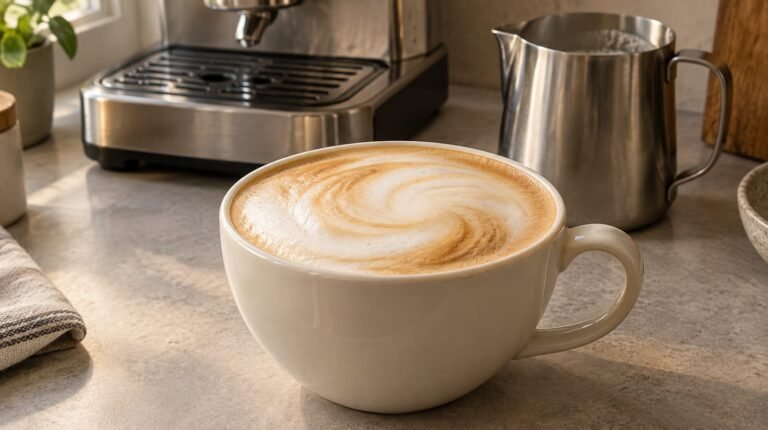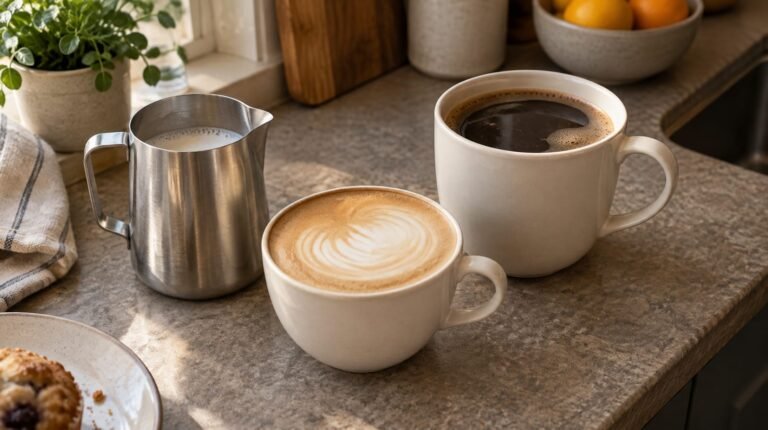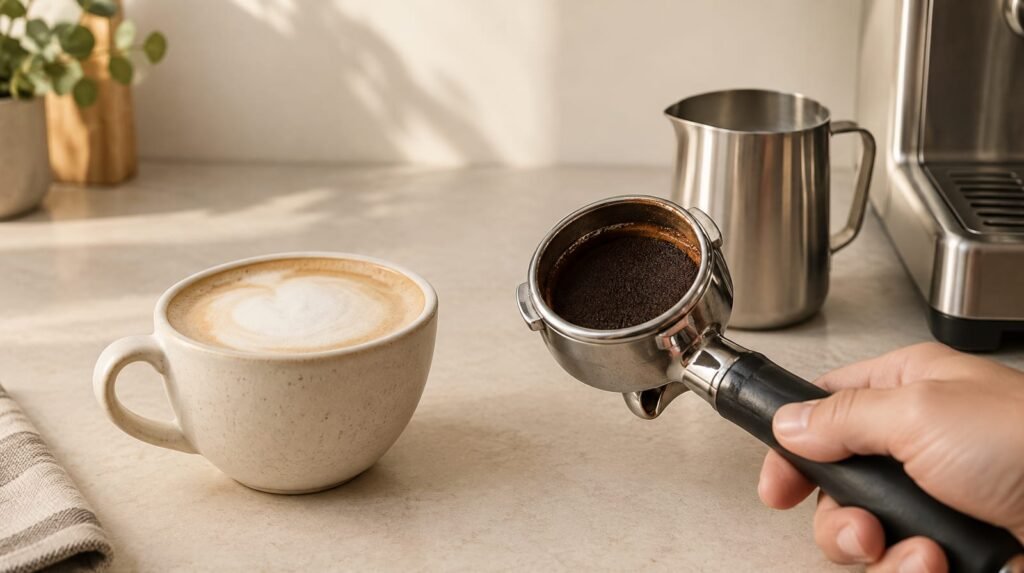
Your latte’s caffeine content matches the caffeine in the espresso used to make it, according to Healthline. Milk adds no extra caffeine.
For a homemade latte, the useful starting point is the espresso allocated to your cup. This guide explains how to estimate that amount when you use a double basket, share an extraction between drinks or change your recipe.
The same approach works for iced drinks. Meraki says hot and iced lattes contain approximately equal caffeine when their espresso doses match. You’ll also learn how to allow for recipe variation and fit your estimate into your daily caffeine intake.
This article was produced with the help of AI and reviewed before publication.
In this article
- How to estimate your latte caffeine content
- Keep track of caffeine when adding milk, ice or flavourings
- Compare caffeine dose rather than coffee flavour
- Fit your latte into your daily caffeine intake
- Make your recipe the starting point
How to estimate your latte caffeine content
Choose a starting estimate
Use about 63 mg per single-shot equivalent as a practical starting estimate. Coffee Friend puts a one-shot latte at 63 mg and a two-shot latte at 126 mg. Treat these as estimates for your calculation.
KaapiKaapi estimates 63–126 mg for a 240 ml latte, depending on whether it contains one or two shots. Bean Box® gives similar estimates: approximately 64 mg for a single and 128 mg for a double.
Other estimates span a wider range. broroastery.com gives about 95–100 mg for a 200 ml latte and 120–180 mg for a double espresso. Coffee Bean Shop lists 173 mg for a two-shot latte, while separately giving 63–77 mg per espresso shot.
Approximately 355 ml is the metric equivalent of 12 US fl oz. For a 12-ounce latte, Lingonberry Roastery & Bakery estimates 60–75 mg with one shot or 120–150 mg with two. Keep each estimate attached to its stated recipe.
Calculate the espresso allocated to your cup
Count the espresso reaching your cup. Meraki says differently sized lattes can contain equal caffeine, while equally sized lattes can contain different amounts. It also notes that a café’s standard preparation may already use two shots or a double basket.
- Record whether your extraction is a single or double espresso, including when you use a double basket.
- Assign an estimated caffeine total to that extraction. Using Coffee Friend’s figures, allow 63 mg for a single or 126 mg for a double.
- Allocate that total between the cups receiving the espresso. Assuming an equal split, a 126 mg double shared between two lattes gives about 63 mg each. Putting the entire double into one latte gives about 126 mg.
- Record your ground-coffee dose and brewed output alongside the allocation. Meraki says keeping dose and output consistent helps make homemade lattes repeatable.
Allow for beans and extraction
Bean Box® says robusta contains almost twice as much caffeine as arabica. It also says using more coffee, grinding finer or extending water contact increases caffeine extraction. Keep your estimate provisional when changing those variables.
Volume alone offers another estimate, with its own limits. broroastery.com gives 57–90 mg for a 30–40 ml espresso. Meraki reports an EFSA reference figure of approximately 80 mg for 60 ml espresso, while noting that café preparations vary.
Treat those figures as alternative reference recipes, not exact volume conversions for your machine. Meraki says measuring your recipe improves comparisons between preparations, but precise caffeine content requires testing data and depends on the coffee used.
With an estimate for the espresso entering your cup, you can now account for the rest of the drink.
Keep track of caffeine when adding milk, ice or flavourings
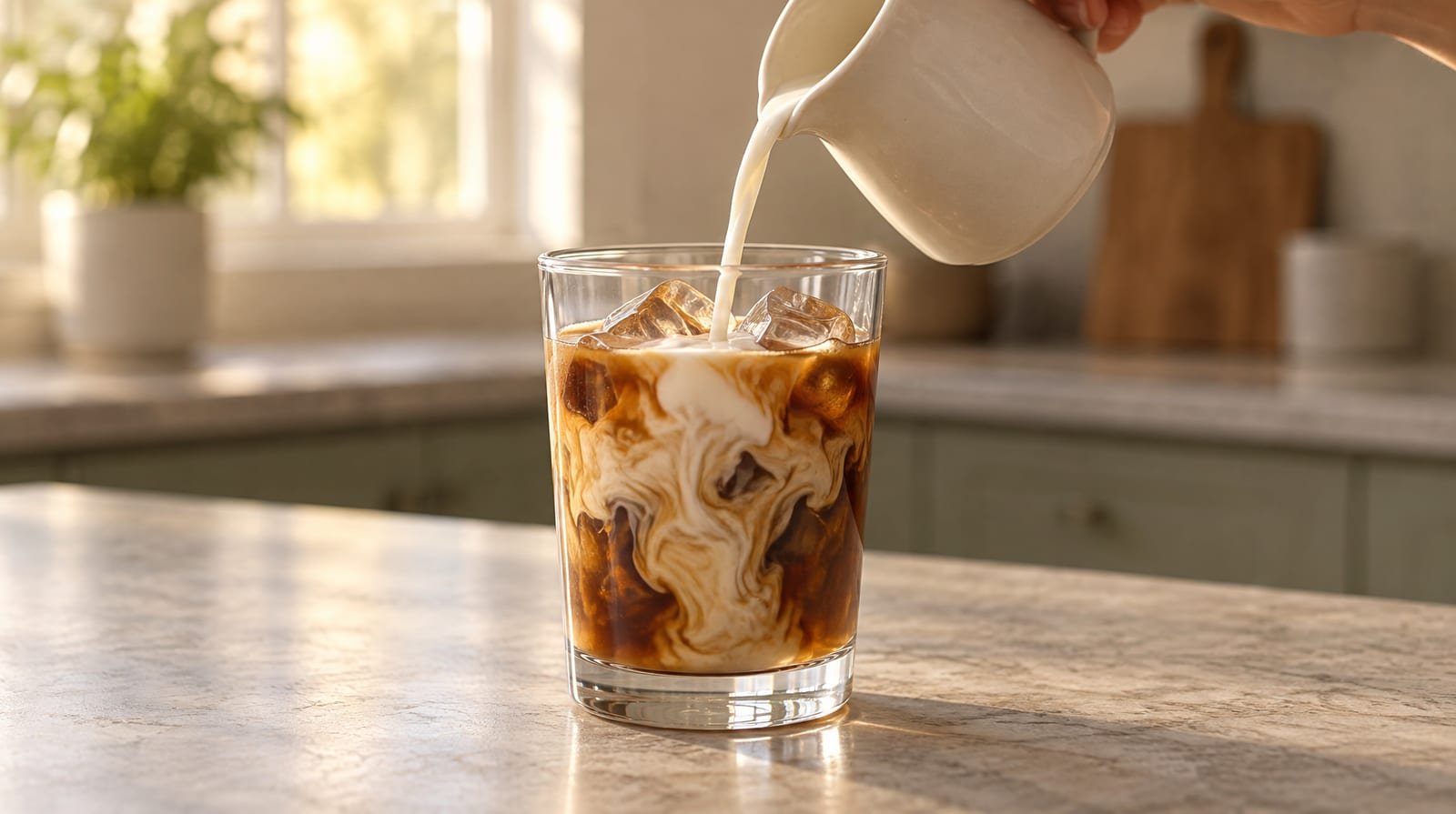
Use the same estimate for hot and iced lattes
Keep your espresso estimate unchanged when making an iced version. Meraki says hot and iced lattes have approximately equal caffeine when their espresso doses match. Adding milk or ice does not remove the espresso’s caffeine.
For a concrete example, horsenden.co.uk gives 126 mg for a 350 ml iced latte containing two espresso shots. Use that as an illustration of a two-shot recipe, keeping the espresso allocation central to your calculation.
Those figures work out at 36 mg per 100 ml. The whole drink still accounts for 126 mg in your caffeine total. The first figure describes concentration, while the second describes the amount in the serving.
Meraki explains that milk reduces bitterness and the caffeine concentration in each sip while leaving the espresso’s total caffeine unchanged. For tracking intake, the useful number is the caffeine in the whole drink you consume.
Count milk and caffeinated add-ins separately
Meraki says ordinary dairy milk and unflavoured oat, almond, soya and coconut alternatives generally contribute no caffeine. It also identifies mocha chocolate and certain coffee-flavoured or functional ingredients as possible additional caffeine sources.
Keep a separate entry for those additions in your recipe record. This makes the calculation easier to update when you change a flavouring while keeping the espresso recipe fixed.
- Record the caffeine estimate for the espresso allocated to your cup as the starting amount.
- Record a separate caffeine amount for each caffeinated addition, using the quantity you actually add and any caffeine-per-portion information on its packaging.
- Add those ingredient amounts to the espresso estimate to calculate your drink’s estimated total.
Treat an unquantified caffeinated addition as an unresolved part of the estimate. Keep the espresso figure visible, but avoid presenting it as the complete total when you cannot quantify the extra ingredient.
Compare caffeine dose rather than coffee flavour
Compare a latte with black coffee
The serving sizes used below are approximately 237 ml (8 US fl oz) and 355 ml (12 US fl oz). Keep those volumes alongside the caffeine figures when comparing drinks.
Aerial Resupply Coffee estimates about 95 mg for an eight-ounce black coffee, compared with about 63 mg for a one-shot latte. Its two-shot latte estimate reaches approximately 126 mg.
Using those estimates, the one-shot latte supplies 32 mg less caffeine than the black coffee. The two-shot version supplies 31 mg more. Choosing a latte therefore does not automatically lower your caffeine intake.
For equal-sized servings, Lingonberry Roastery & Bakery gives a broader comparison: 60–150 mg for a 12-ounce latte and 140–180 mg for a 12-ounce brewed coffee. It says lattes usually contain less caffeine without extra espresso shots, while recipes vary between cafés.
These comparisons answer slightly different questions. The first shows how an extra espresso shot can reverse the result. The second compares equal drink volumes, with overlapping caffeine ranges. For your own recipe, compare the estimated milligrams in the complete serving you intend to drink.
Compare drinks made with the same espresso
Meraki says a cappuccino and latte contain equal caffeine when their espresso recipes match. Coffee Bean Shop gives the same principle for a latte and americano made with equal quantities of espresso.
For a practical comparison, treat the espresso allocated to your cup as the fixed starting point. Changing the drink style alone gives you no reason to assign a different caffeine estimate.
A flat white needs a recipe check: Meraki says it can contain more caffeine than a latte when it uses more espresso. Choose between these drinks for flavour and texture, then judge caffeine by the espresso recipe behind each one.
Comparing drinks helps you choose your next coffee. Your daily total puts that choice into context.
Fit your latte into your daily caffeine intake
Put a 200 mg drink in context
Mayo Clinic says a daily caffeine intake of up to 400 mg appears safe for most adults. A 200 mg latte accounts for half that amount. Apply this reference to your whole day’s intake. It does not establish a safety threshold for an individual drink.
Your response also matters. Mayo Clinic says sensitivity varies, and even small amounts can leave sensitive people restless or struggling to sleep. Treat those effects as a reason to consider reducing your intake, even when your total falls below the daily reference.
Count a latte during pregnancy
Bradenton Hometown Pharmacy reports that the American College of Obstetricians and Gynecologists recommends keeping caffeine intake below 200 mg daily during pregnancy. Include your latte within that total.
- Enter your latte estimate in your daily tally. Using Coffee Friend’s figures, allow 63 mg for one espresso shot or 126 mg for two.
- Add the caffeine from everything else you consume that day, including other caffeinated drinks and additions.
- Check that the combined total stays below 200 mg. Either latte estimate can fit, depending on how much other caffeine you consume.
Mayo Clinic recommends discussing personal caffeine limits with a healthcare professional if you are pregnant, breastfeeding or planning a pregnancy. It also cautions that caffeine can be unsuitable for people taking certain medicines.
Lower the caffeine in your next latte
For a lower-caffeine recipe, choose fewer espresso shots or use decaf. Keep a caffeine allowance for decaf too: Mayo Clinic says decaffeinated drinks retain some caffeine. Meraki also notes that adding more decaf shots can increase the total. Decaf is therefore a reduction option, with its remaining caffeine still counted towards your day.
Make your recipe the starting point
You can now estimate your latte from the espresso allocated to your cup, including a shared extraction. Coffee Friend’s working figures are 63 mg for one espresso shot and 126 mg for two.
A record of your coffee dose, brewed output and share of the extraction gives you a practical basis for comparing recipes. Keep the result labelled as an estimate. Meraki says recipe measurements improve comparisons but cannot establish precise caffeine content.
For a lower-caffeine latte, reducing the espresso allocation is the clearest starting point. Meraki says milk lowers caffeine concentration without reducing the espresso’s total caffeine. Use your estimated serving total when deciding how the drink fits into your day.
Sources
- How Much Caffeine in a Cup of Coffee? A Detailed Guide — healthline.com
- How Much Caffeine Is in a Latte? Count the Espresso Shots — merakitech.com
- How much caffeine in a cup of coffee? — coffeefriend.co.uk
- How Much Caffeine is in Your Coffee? A Breakdown by Coffee Type (Espresso, Latte, Macchiato, Cold Brew) — kaapikaapi.com.au
- Caffeine Calculator: How Much Caffeine Is in Your Coffee? — beanbox.com
- How much caffeine is in coffee? Find out how much caffeine is in espresso, latte and other types of coffee — broroastery.com
- How much caffeine is in a latte? — coffeebeanshop.co.uk
- Exploring the Caffeine Content of Various Coffee Drinks — lingonberrycafe.com
- Caffeine Content in Latte: Does It Have Any? — horsenden.co.uk
- Latte vs Coffee: What Is the Actual Difference? — aerialresupplycoffee.com
- Caffeine: How much is too much? — mayoclinic.org
- A Little Coffee May Be Healthy in Pregnancy — bradentonhometownpharmacy.com