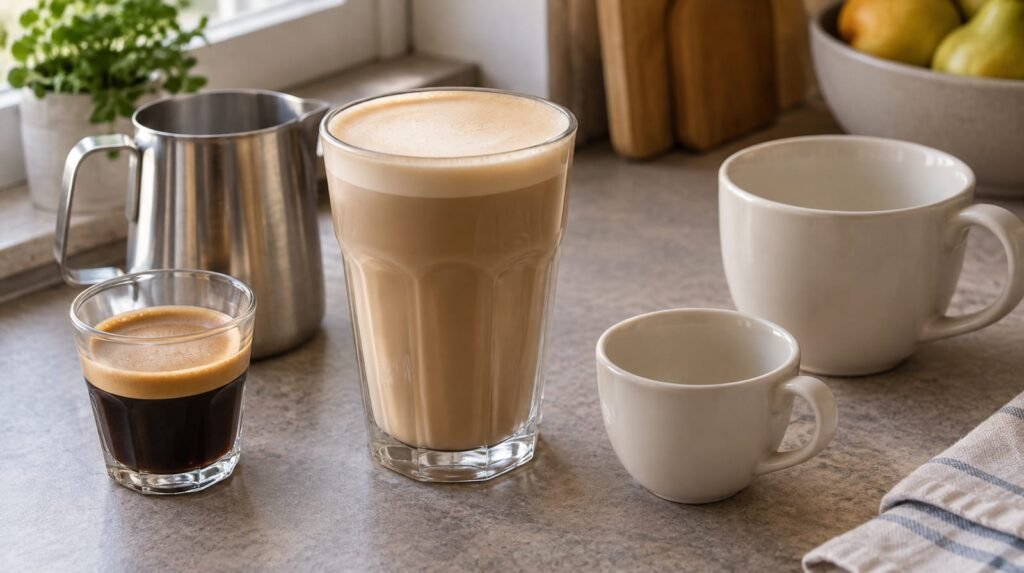
A latte is a coffee drink made with espresso, steamed milk and a thin topping of milk foam. That is the basic definition; the useful next question is how to balance those ingredients in your own cup.
Too much milk can leave a latte tasting overly milky even when the espresso is well made. For a beginner, that makes the balance between coffee and milk a better starting point than copying a café’s serving size.
This guide explains the differences between similar orders, then helps you choose quantities for a hot or iced version. It also separates coffee flavour from caffeine strength and shows how to estimate what your milk and extras add.
This article was produced with the help of AI and reviewed before publication.
In this article
- What is a latte coffee?
- Build a hot latte recipe for your cup
- Make an iced version
- Judge strength by the espresso, not the milk
- Work out what your milk and extras add
- Compare café prices and understand latte powder
- Build a latte that suits your cup
What is a latte coffee?
A latte, also called caffè latte, usually starts with one or two espresso shots. Milk accounts for most of its volume, while finely textured milk foam gives it a creamy feel. Its coffee flavour is mild rather than forceful.
In Italian, latte means milk. If you order simply a latte in Italy, you may receive plain milk rather than coffee; caffè latte makes the distinction.
Latte versus cappuccino
A latte generally has more steamed milk than a cappuccino, giving it a milkier, milder taste. Its thin microfoam topping has tiny bubbles and a creamy texture.
That gentler taste does not automatically mean less caffeine. NESCAFÉ explains that, with equal espresso quantities, latte and cappuccino contain equal caffeine. Choose the latte for a milk-led drink, or cappuccino when you prefer more foam and a more pronounced coffee flavour.
Latte versus macchiato
A traditional espresso macchiato uses much less milk than a latte and tastes bolder. NESCAFÉ describes its balance as two parts espresso to one part milk. It is the better fit when you want coffee to lead.
Latte macchiato is a different drink: espresso is poured into steamed milk, reversing the usual latte order. Its appearance is layered, with milk below, espresso in the middle and foam above. Do not treat the two macchiato names as interchangeable.
With the drink names clear, the next decision is practical: how much espresso and milk will suit your cup?
Build a hot latte recipe for your cup

Choose your espresso and milk quantities
UE Coffee Roasters recommends a 30–40 ml double espresso and at least three parts steamed milk per part espresso. Use that as a starting point, not a universal formula.
At that minimum ratio, 30 ml espresso plus 90 ml steamed milk gives 120 ml; 40 ml plus 120 ml gives 160 ml. Choose the smaller combination for a smaller cup rather than automatically filling a large mug.
Make your hot latte
- Brew UE Coffee Roasters’ recommended 30–40 ml double espresso directly into your cup.
- Fill a milk jug one-third full with whole milk, as Caffè Society recommends.
- Briefly purge the steam wand before putting its tip just below the milk’s surface to introduce air.
- After several short chirping sounds, lift the jug and move the wand towards its side to create a swirl.
- Stop steaming at 60–65°C, UE Coffee Roasters’ recommended range; overheating can give the milk a scalded taste.
- Tap the jug lightly to remove large bubbles, then pour into the espresso. Start with the jug higher, lowering and tilting it further as you pour, leaving only a thin foam topping.
Adjust a milky, watery or harsh result
- Taste the espresso alone to isolate dilution. If it tastes satisfactory, try less milk or a smaller cup.
- Measure coffee dose and espresso yield before changing grind. Meraki recommends 18 g in and 36–40 g out as a double-espresso starting point, adjusted for equipment and preference.
- Check fast flow next. Meraki identifies a double completed in 15 seconds as too fast; try a finer grind.
- Check for channeling if the espresso tastes both watery and harsh. Correct coffee distribution and basket-dose compatibility before further grind changes.
- Check bean freshness. Replace coffee beyond the roaster’s recommended freshness window before making further grinder or machine adjustments.
Make an iced version
An iced latte combines espresso, cold milk and ice. Flavourings and sweeteners are optional, so you can start with the plain drink and decide whether it needs anything extra.
Grind gives a usual balance of one part espresso to two parts cold milk. For this version, use NESCAFÉ’s unheated frothing method: cold milk can form foam with a whisk or milk frother.
A scaled starting example is 40 ml espresso with 80 ml cold milk. That gives 120 ml of ingredients before frothing and adding ice; it is a recipe quantity, not a target glass capacity.
- Prepare 40 ml espresso for this example.
- Froth 80 ml cold milk in your serving glass using a whisk or milk frother. Keep the milk unheated, as NESCAFÉ directs; this version does not need steaming.
- Pour the espresso through the cold milk foam, following NESCAFÉ’s order of assembly.
- Mix in sugar, syrup or another flavouring if wanted. Grind allows optional sweetening before the drink goes onto ice; leave it out for a plain version.
- Add ice to finish. NESCAFÉ suggests ice for a colder drink, while Grind includes it as part of an iced latte.
Once you have chosen a hot or iced recipe, consider what you mean by strength: coffee flavour or caffeine.
Judge strength by the espresso, not the milk
A mild coffee flavour is not a caffeine measurement. For your latte, distinguish how strongly you taste the coffee, its caffeine concentration and the total caffeine in your cup.
Majesty Coffee estimates about 64 mg of caffeine for one espresso shot, or around 128 mg for two. Treat these as approximate amounts rather than exact targets.
Majesty Coffee explains that milk lowers a latte’s caffeine concentration. Adding milk therefore spreads the espresso’s caffeine through a larger drink; it does not remove that caffeine.
For example, using its single-shot estimate, adding more milk still leaves about 64 mg in the finished cup. The concentration falls, but the total stays the same.
For a brewed-coffee comparison, approximately 237 ml is the metric equivalent of an 8 US fl oz serving. Majesty Coffee gives roughly 100–140 mg of caffeine for an 8-ounce serving of brewed coffee.
On those estimates, a double-shot latte falls within the brewed-coffee range, despite its milder taste. Majesty Coffee also notes that bean variety, brewing technique and serving size can substantially change brewed coffee’s caffeine content.
Use the espresso quantity to judge your likely caffeine intake, rather than the drink’s milkiness. Choose the milk balance for flavour, not as a way to reduce the caffeine already in your espresso.
Work out what your milk and extras add
Choose milk for texture and flavour
For an iced latte, Grind describes whole milk as giving more body and creaminess than almond or skimmed milk. Choose it when texture matters more than reducing calories.
UE Coffee Roasters describes steamed oat milk as thick and creamy, with gentle sweetness and a fairly neutral flavour. Almond produces a lighter texture with a nutty note; soya offers richness with a slightly savoury taste. Oat is therefore a useful starting point if you want a creamy dairy alternative.
Milk also brings naturally occurring sugars, which sweeten the espresso without added sweeteners. Nutrients depend on the recipe: Allrecipes gives 4 g protein per serving for its latte, not for every latte.
Estimate calories from your ingredients
Your milk quantity, milk choice and sweeteners determine the nutritional total. Modern Standard Coffee calculates dairy milk at 65 kcal per 100 ml for whole, 47 for semi-skimmed and 35 for skimmed.
- Measure the milk going into your drink. Multiply its volume in ml by the relevant figure above, then divide by 100. For example, 200 ml whole milk contributes 130 kcal.
- Count the espresso shots. Modern Standard Coffee allows approximately 3 kcal per shot. Two shots bring this example to 136 kcal.
- Measure any syrup. Modern Standard Coffee estimates that a typical 10 ml portion contributes about 34 kcal and 8 g sugar. Adding that portion brings the example to 170 kcal.
- Count added sugar separately. Modern Standard Coffee assigns 16 kcal to a teaspoon holding 4 g sugar. One teaspoon brings this example, including the syrup, to 186 kcal.
Treat the result as an estimate: Modern Standard Coffee cautions that milk brands and pouring practices affect the figures.
You can now assess your own recipe. Use the same attention to ingredients and serving size when comparing café orders and instant alternatives.
Compare café prices and understand latte powder
Amara Bakery’s menu gives one café example of how latte prices vary by size:
| Latte size | Listed price |
|---|---|
| Small | £3.60 |
| Medium | £3.90 |
| Large | £4.20 |
These are Amara Bakery’s listed prices, not a UK-wide average or a live quote. Each size increase costs 30p; the large costs 60p more than the small. Treat that as a comparison within this café, rather than a benchmark every café should meet.
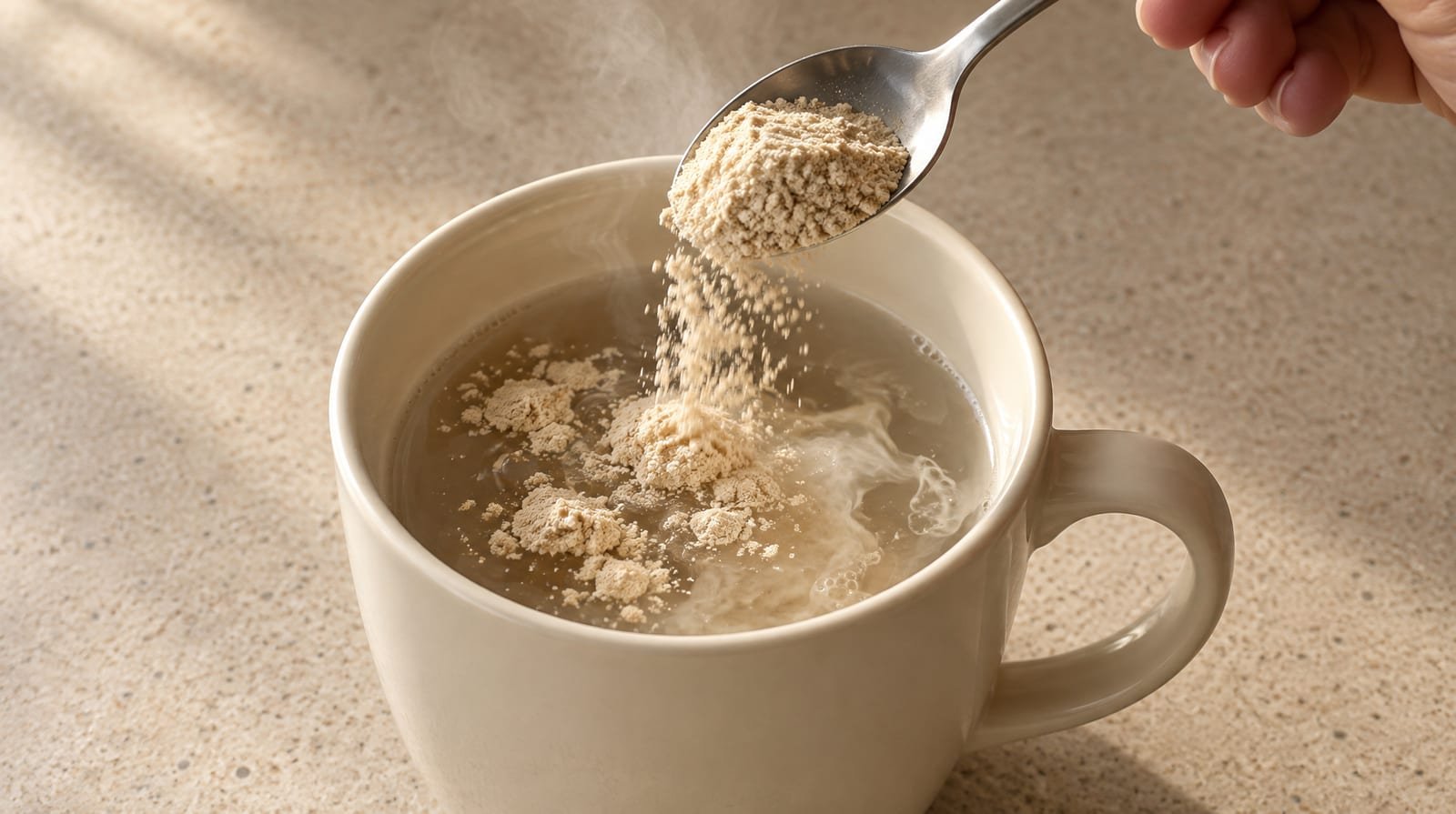
Latte powder is a different proposition: an instant latte product, rather than the traditional espresso-and-steamed-milk drink. Tesco, for example, groups these products as instant coffee sachets.
NESCAFÉ says its latte and cappuccino versions use instant coffee dissolved in hot or cold water. That distinguishes their coffee base from a machine-made espresso drink.
For your home-espresso latte, stay with espresso and separately textured milk. That is the practical route for building a recipe around your cup; an instant latte product is an alternative drink, not a required ingredient.
Build a latte that suits your cup
A measured recipe is a better starting point than copying a café’s cup size. UE Coffee Roasters gives a typical ratio of one part espresso to at least three parts steamed milk. Treat that as your baseline for balance, rather than a target serving size.
Meraki explains that excessive milk can make a latte taste too milky even when the espresso is well made. For a beginner, the useful goal is therefore balance, not simply more coffee or a bigger drink. You can now choose your quantities, distinguish similar orders and estimate what your milk and extras contribute.
Sources
- What is a latte? — nescafe.com
- Why Is My Espresso Watery and Weak? — merakitech.com
- What is a latte? — nescafe.com
- What Is a Latte Coffee? The Ultimate Guide to Britain’s Favourite Brew — uecoffeeroasters.com
- What is the Different Between a Latte and a Cappuccino — nescafe.com
- Latte vs. Macchiato: What is The Difference? — nescafe.com
- Latte – Wikipedia — en.wikipedia.org
- Article – Latte, Caffe Latte, Latte Macchiato, Cappuccino… what does it all mean? — liminicoffee.co.uk
- How to Make the Perfect Latte | Barista Tips — caffesociety.co.uk
- Iced Latte vs Iced Coffee — grind.co.uk
- Caffeine in Lattes vs Coffee: Unraveling the Differences — majestycoffee.com
- How to Make a Cafe Latte — allrecipes.com
- Coffee Calorie Calculator — modernstandardcoffee.co.uk
- Latte Coffee | Smooth & Creamy Café Favourite in Chingford — amarabakery.co.uk
- Latte Instant Coffee Sachets — tesco.com