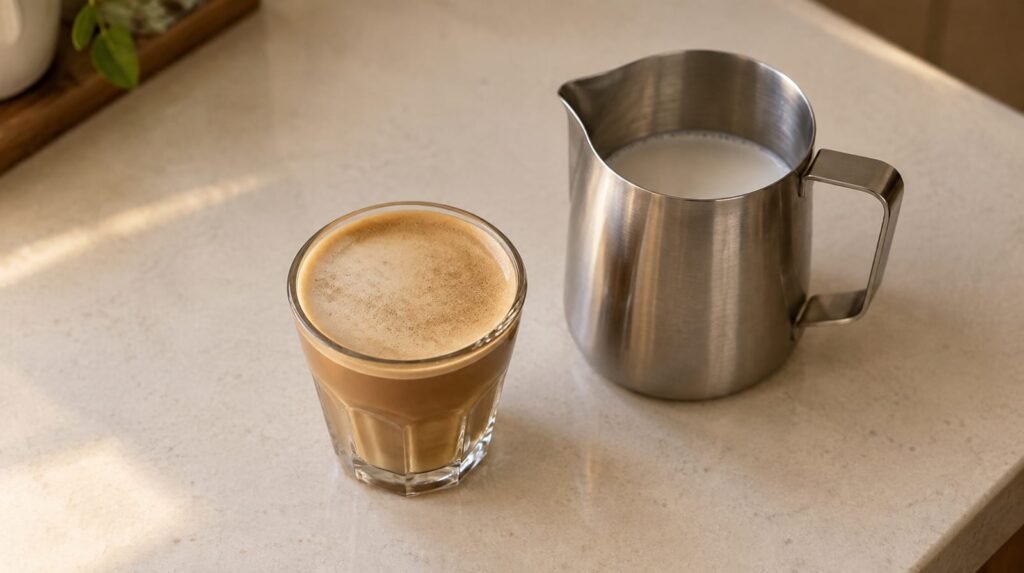
A cortado coffee combines espresso with an equal quantity of steamed milk. According to 787 Coffee, the milk reduces the espresso’s bitterness and acidity.
At home, distinguish between the milk you pour into the drink and the amount you prepare in the jug. Meraki’s recipe allocates 40–55 g of steamed milk per cortado. It also says most steam wands cannot texture that small an amount evenly, so its method anticipates leftovers.
This guide explains the taste, compares familiar milk coffees and gives you a home recipe. The milk-planning calculation helps you work out how many drinks your milk will make and what will remain, rather than treating every jugful as one serving.
This article was produced with the help of AI and reviewed before publication.
In this article
- What is a cortado coffee?
- Choose between a cortado and other milk coffees
- Plan your milk and calculate leftovers
- Make one at home
- Order your preferred size, shots and milk
- Choose the balance, then plan the milk
What is a cortado coffee?
A cortado is a small Spanish coffee served with warm milk and little or no foam. Think of a compact milk coffee, rather than a drink topped with a thick, frothy cap.
Cortado means cut in English. It comes from the Spanish verb cortar, meaning to cut: the name describes cutting the espresso with milk.
The espresso flavour stays more prominent than in a latte, where the larger quantity of milk makes the drink milder. Choose a cortado if you enjoy a clear coffee flavour but want milk to soften its edge.
Picture a serving of about 120 ml, rather than a large mug. Canal Coffee Company gives a cortado serving range of approximately 60–120 ml (2–4 oz). Treat 120 ml as the upper end of that range, not a compulsory serving size.
Regional differences matter too. In Spain, a cortado can mean espresso with only a little milk added. Elsewhere, versions can use two espresso shots or different milk quantities. Treat the name as a guide to the style, rather than a guarantee of an identical drink in every café.
Choose between a cortado and other milk coffees
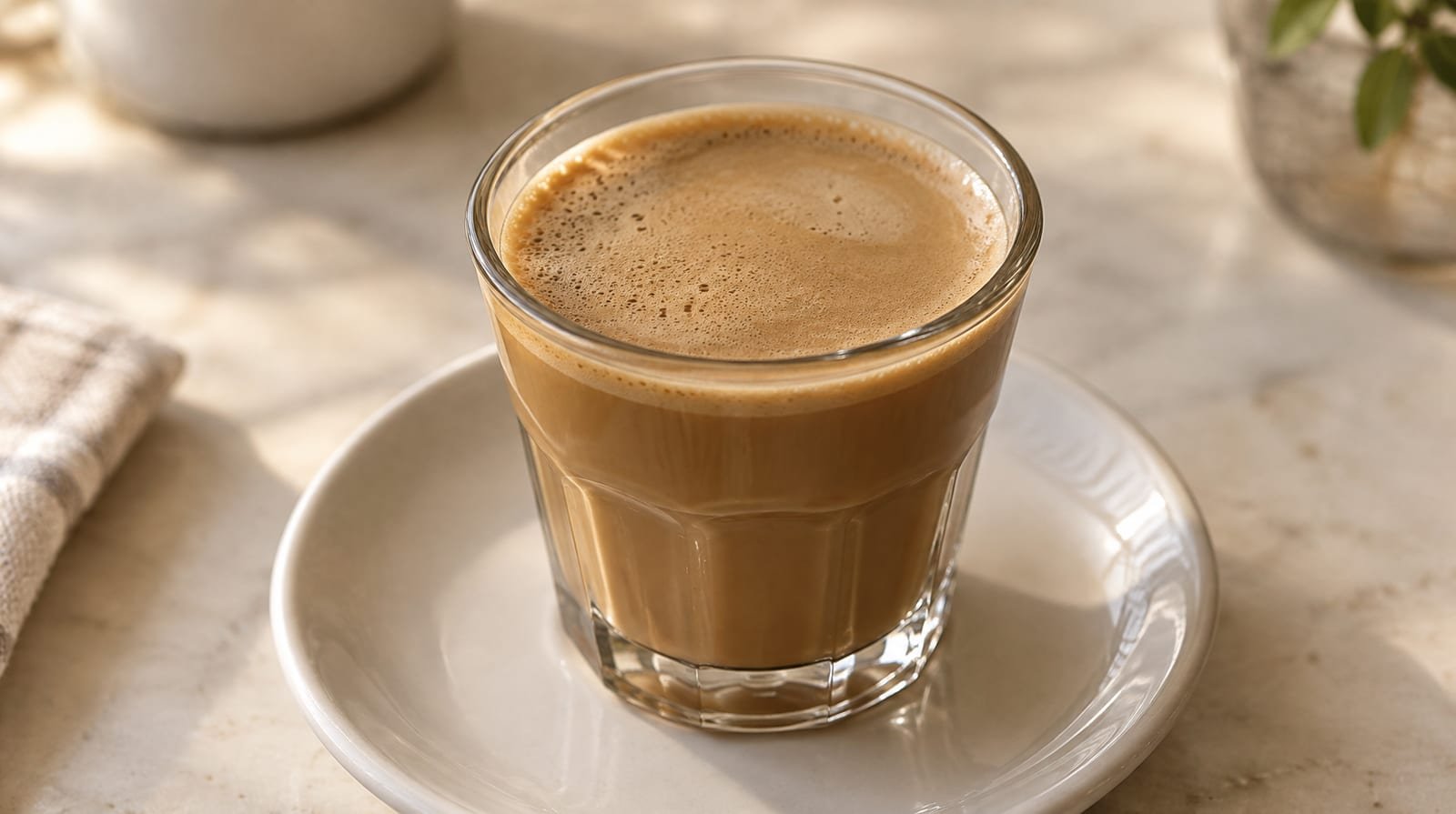
A cortado is not a flat white. Nescafé describes the flat white as milkier, with more textured foam, a smoother mouthfeel and a less intense coffee taste.
Use the cortado’s milk balance as your reference. Choose according to whether you want more milk, a different texture or greater coffee intensity.
| Alternative | How it compares | Choose it when… |
|---|---|---|
| Flat white | More milk and a thin microfoam layer, according to Colipse. | You want a smoother drink without moving straight to a latte. |
| Latte | Usually one part espresso to three or four parts milk, with microfoam; typically a larger serving. | You want a longer, milk-focused drink. |
| Piccolo | One espresso shot in a small macchiato glass, topped with latte-style steamed milk. Colipse places its coffee intensity below a cortado’s. | You want a small drink with gentler coffee intensity. |
| Espresso macchiato | Colipse places its coffee intensity above a cortado’s. | Coffee intensity matters most. |
| Cappuccino | More milk relative to coffee and thicker foam than a cortado, according to Colipse. | You prefer a more pronounced foam layer. |
Stronger flavour does not automatically mean more caffeine. Canal Coffee Company identifies espresso-shot count as the main caffeine determinant for cortados and lattes. Compare the shots rather than judging caffeine by milkiness or cup size.
Once you have chosen your drink, plan the milk for the jug separately from the portion for the glass.
Plan your milk and calculate leftovers
Allow enough milk for the steam wand
Meraki recommends starting with approximately 90–120 ml of cold milk (3–4 US fl oz), using the smallest pitcher suitable for steaming. That starting quantity provides enough depth for the wand to create a controlled whirlpool.
Treat the cold fill and the amount allocated to each drink as separate quantities. For planning, use the final steamed milk available in grams, rather than entering the cold fill in millilitres.
Calculate how many drinks your milk will make
Use this calculation to check whether a batch covers your intended drinks, or how much will remain after pouring.
- Enter the weight of steamed milk available, in grams.
- Set the milk portion per drink in grams. Use 45 g as the default, following Meraki’s suggested starting portion.
- Enter the number of drinks you want to make.
- Calculate leftover milk in grams: available milk − (drink count × portion). A positive result is milk remaining; a negative result is the shortfall.
For example, two 45 g portions require 90 g of steamed milk. With that amount available, two drinks leave nothing; requesting three produces −45 g, meaning you are 45 g short.
To calculate capacity instead, divide available grams by grams per drink and round down to the nearest whole drink. Keep the portion fixed when comparing batches, so the calculation answers the same question each time.
With the milk allocation worked out, you can put that plan into practice.
Make one at home
Follow the espresso-machine recipe
Meraki’s weight-based recipe gives you a repeatable starting point, rather than matching volumes. Meraki notes that crema and aerated milk contain gas, making volume measurements less precise.
- Warm a 120–150 ml glass with hot water, then empty and dry it.
- Put 18 g of freshly ground coffee into the portafilter, distribute it evenly and tamp level.
- Brew 36–40 g of espresso into the glass. Meraki prioritises balanced flavour over an exact extraction time.
- Steam approximately 90–120 ml of cold milk in the smallest suitable pitcher. Introduce minimal air initially, aiming for a brief, quiet hiss, and stop at 55–60°C.
- Swirl the pitcher to mix the milk evenly, tapping it lightly first if you see a stray bubble.
- Pour 45 g of steamed milk into the espresso, following Meraki’s starting recipe.
- Taste and drink promptly.
Adjust the next drink to your taste
Bean Box recommends changing only one brewing variable between tastings. Use that approach to separate milk-balance adjustments from espresso corrections.
- Adjust the milk balance: Meraki recommends adding 5 g if the finish is harsh, or removing 5–10 g next time if milk hides the coffee.
- For sour espresso, follow Bean Box’s correction: grind one or two settings finer while keeping the dose and output unchanged.
- For watery espresso, try Bean Box’s shorter-yield option: retain an 18 g dose but reduce a 36 g output to 30 g.
- For excessive foam, return to Meraki’s minimal-air technique: keep the initial hiss brief rather than prolonging aeration.
Use your preferred home balance as a guide when explaining what you want at a café.
Order your preferred size, shots and milk

Specify the shots and milk
Two or three shots do not define every cortado. Reviva Coffee describes an early one-shot version; current recipes from KitchenAid and Canal Coffee Company use a double espresso.
Colipse describes the Starbucks Cortado as approximately 237 ml, with three ristretto shots of Starbucks Blonde Espresso. Treat that as a particular café’s version, not the default everywhere.
- Ask which size and shot count the café serves, then specify whether you want one or two shots.
- State your milk choice and preferred balance. For example, request a double-shot cortado with whole milk, roughly equal espresso and milk, very little foam and no syrup.
Estimate calories and caffeine
Canal Coffee Company estimates approximately 50–70 kcal for a whole-milk cortado and says changing the milk can raise or lower that total. Use this as a starting estimate, not a fixed allowance.
Sweetened versions need a separate estimate. Colipse describes Starbucks’ brown sugar version as containing oat milk, cinnamon and brown sugar syrup, with approximately 130 kcal.
For caffeine, Canal Coffee Company estimates about 128 mg for a typical double-shot cortado. Colipse puts the three-ristretto Starbucks Cortado at approximately 230 mg. Keep those caffeine estimates separate from your milk and sweetness choices.
Choose the balance, then plan the milk
Choose a cortado if you want more prominent espresso flavour than a latte offers. Canal Coffee Company attributes that difference to the latte’s greater milk content. When ordering, prioritise the balance you enjoy rather than the drink’s name alone: 787 Coffee describes regional variations in shots and milk quantities.
For your home starting point, Meraki recommends 36–40 g of espresso with 45 g of milk. Keep that serving target separate from the jug fill: Meraki’s method explicitly allows for leftover milk. Use the calculator to plan your portions, rather than treating an empty jug as the goal.
Sources
- What Is A Cortado? History, How-To & 787 Coffee | 787 Coffee — 787coffee.com
- Cortado Recipe: Espresso-to-Milk Ratio and Easy Steps — merakitech.com
- Cortado – Wikipedia — en.wikipedia.org
- Cortado vs Latte: Size, Milk Ratio & Flavor Breakdown — canalcoffeecompany.com
- What Is a Cortado? Types, Calories, and How to Make It — colipsecoffee.com
- Cortado Vs Flat White: What is The Difference? — nescafe.com
- What Is Cortado: Latin Americas’s Favourite Coffee Order — reviva-coffee.com
- Sour, Bitter, or Watery Espresso? Fix Each Symptom — beanbox.com
- Cortado | KitchenAid UK — kitchenaid.co.uk