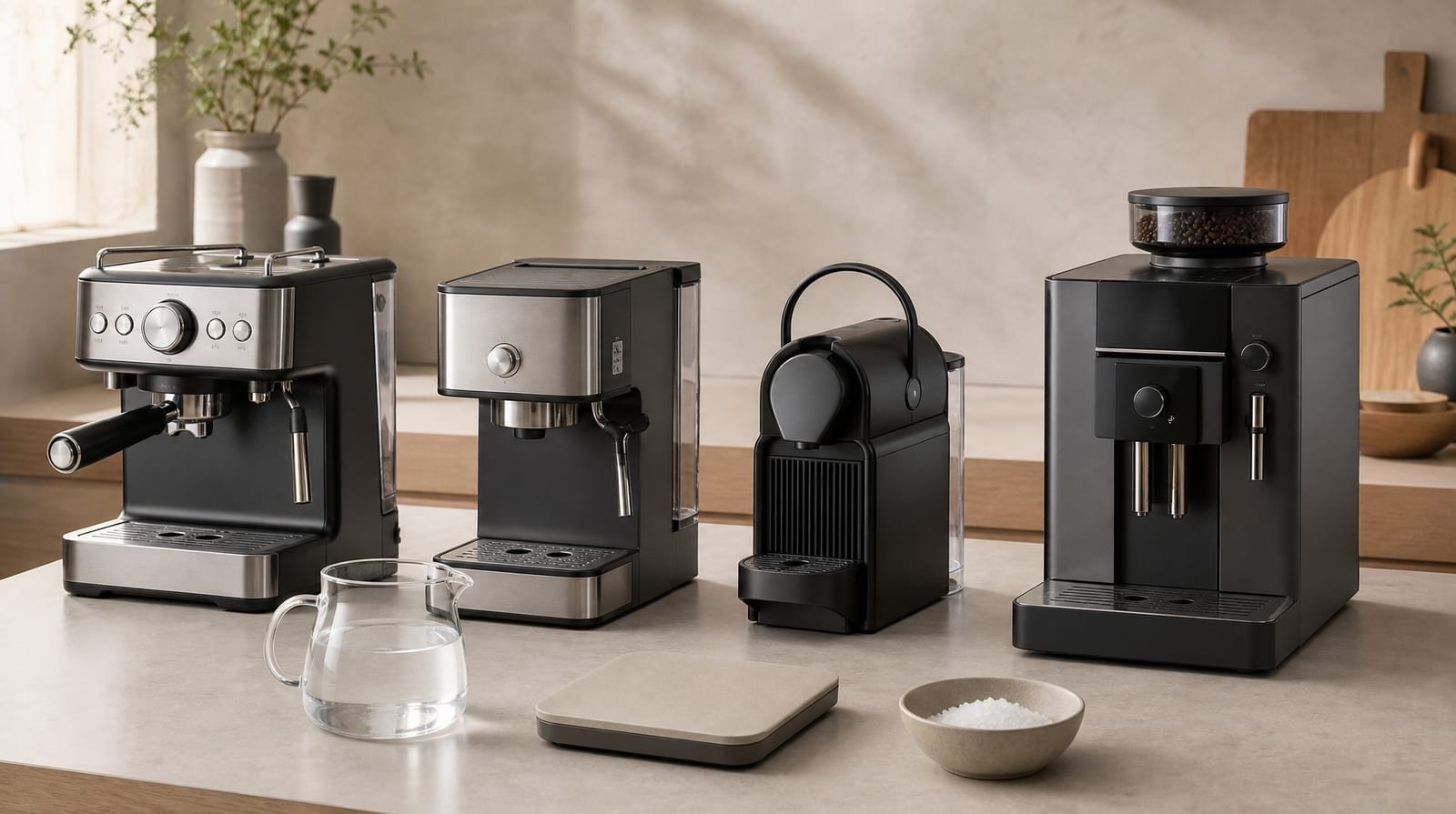
Here is how to descale an espresso machine without descaler: use food-grade citric acid when your machine permits it. A practical range is 15–25 g per litre of water, capped at 15 g per litre for an aluminium boiler.
One recipe is not suitable for every espresso machine. De’Longhi designs its descaling cycles for lactic acid only, while automatic and capsule machines commonly have dedicated programmes. Heat-exchanger and dual-boiler machines may require draining rather than a simple tank flush.
This guide helps you identify the correct pathway, judge whether citric acid is suitable and rinse every treated outlet. Vinegar is only a fallback when the manufacturer permits it because it can attack seals and leave a persistent taste.
This article was produced with the help of AI and reviewed before publication.
In this article
- How to descale espresso machine without descaler
- Check that limescale is the problem
- Choose the pathway for your machine
- Which household substitutes are suitable?
- Flush the system and check the result
- Reduce future limescale build-up
- Choose the method your machine allows
How to descale espresso machine without descaler
Use food-grade citric acid as the main substitute
Food-grade citric acid is the most practical household substitute because commercial descalers commonly use it, and it avoids vinegar’s strong smell. However, a homemade solution is not suitable when the manufacturer specifies another acid or requires an approved product. De’Longhi, for example, designs its descaling cycles for lactic acid only.
Measure 15–25 g per litre of water
Use 15–25 g of food-grade citric acid per litre, adjusting for boiler material and water hardness. A useful starting point for a stainless-steel machine with medium-hard water is 20 g per litre. Therefore, a 1.5-litre tank needs 30 g. Keep to 15 g per litre for an aluminium boiler; guidance for hard water increases the dose to about 25 g per litre.
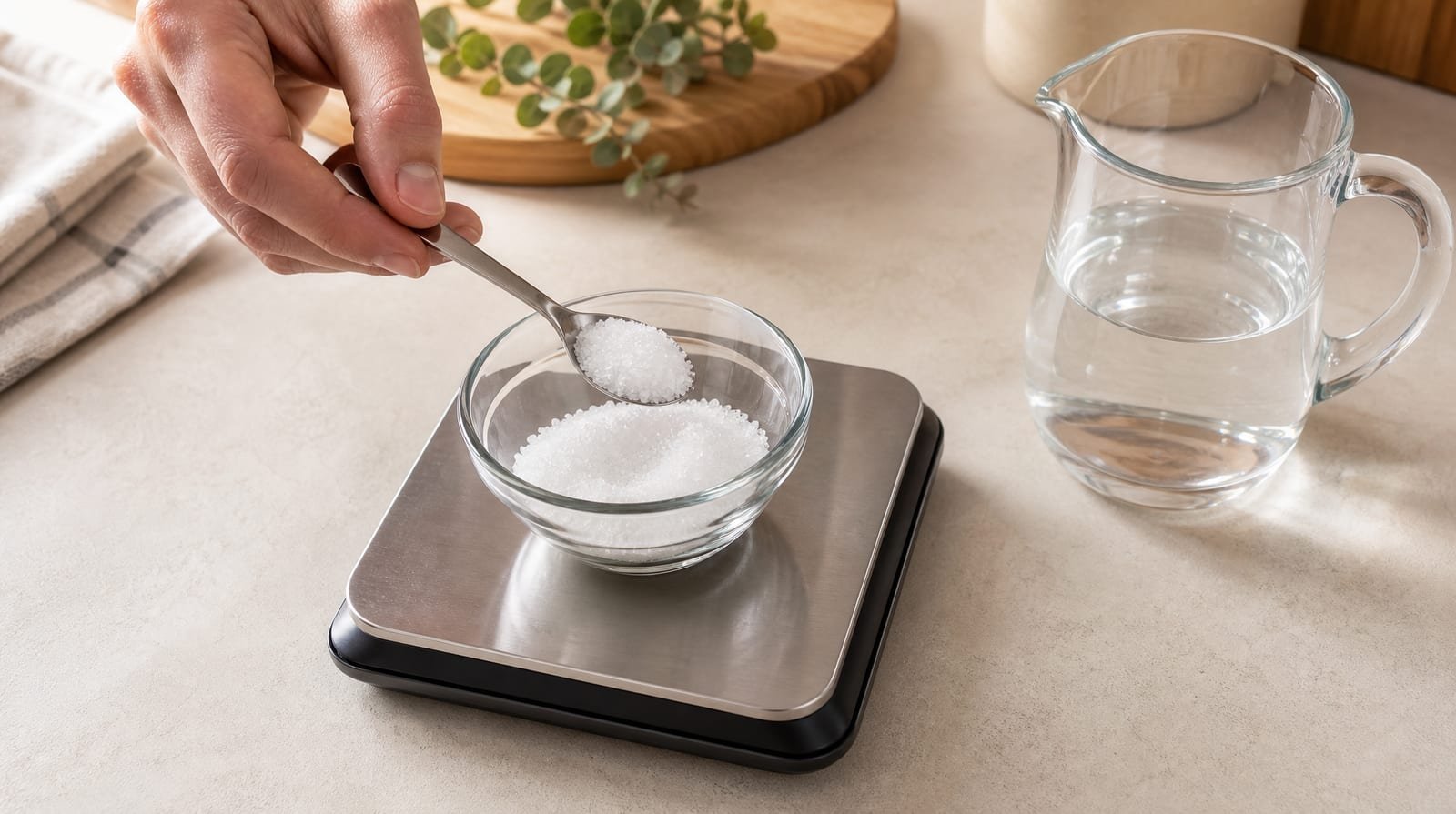
Prepare enough solution to match the tank’s capacity rather than making a concentrated partial tank. Stronger is not necessarily better: acid can loosen thick scale into flakes that lodge in valves, pipes or probes.
Empty and wash removable parts first
Before descaling, empty and rinse the water tank and drip tray, then remove the portafilter and any tank filter cartridge.
Run the solution, then rinse with fresh water
This method suits a tank-fed traditional machine with a removable reservoir. Check your manual before you start: some machines run a guided descaling programme, and descaling certain models by hand can void the warranty. Heat-exchanger and dual-boiler machines often have to be drained rather than flushed, while most capsule and bean-to-cup machines have their own descaling mode.
- Remove the portafilter and water-filter cartridge, then empty and rinse the tank and drip tray.
- Dissolve the calculated amount of food-grade citric acid completely in room-temperature water; for a ceramic boiler, warm the solution to about 50°C instead.
- Fill the reservoir with the solution and place a sufficiently large container beneath the group head and steam wand.
- Bring the machine to operating temperature and follow its own instructions on routing. If they permit the group-head route, discharge about one-third of the tank through it, then open the steam valve for 15–20 seconds. Some espresso guidance advises against this route because acid can attack the group gasket.
- Switch the machine off and leave the solution inside for 15–20 minutes so the acid can act on mineral deposits.
- Using only the outlets permitted for the model, run the remaining solution alternately through the group head or brew outlet, steam wand and hot-water outlet, where fitted, until the tank is empty.
- Remove and rinse the reservoir thoroughly, then refill it with fresh water.
- Run three full tanks of fresh water through every treated outlet; run a fourth tank where the water is hard.
- Pull and discard one espresso. If it tastes acidic or sour, run another fresh-water rinse before making a drink.
Before choosing a treatment, decide whether descaling is the right job at all.
Check that limescale is the problem
Signs of mineral build-up
Look for a pattern rather than relying on one symptom. Possible signs include slower flow, longer heating, unstable temperature, weaker steam and white deposits around fittings.
Limescale forms a white, chalky layer as minerals from the water accumulate. That visible residue, combined with changes in flow or heat, makes scale a more convincing diagnosis.
Scale versus coffee oils or a physical blockage
Descaling targets mineral deposits in the boiler and water pathways. Old coffee oils can instead cause stale smells, so odour or coffee-coloured residue alone points towards cleaning rather than descaling.
- Run the machine without coffee or a capsule, then observe the water flow, heating and steam performance.
- Compare every available outlet. Problems across several water pathways fit internal scale better than a restriction confined to one removable part.
- Inspect removable parts and accessible crevices for residue or an obstruction, using a brush or sponge where appropriate. Clean these areas before deciding that acid treatment is necessary.
Once descaling is justified, match the method to the machine’s water system.
Choose the pathway for your machine
Choose by water path, not appearance. The safest route is the machine’s own programme where one exists; otherwise, descale by hand with citric acid only when the model permits it. Manual descaling can affect the warranty on some guided machines.
Traditional boiler machines
For a tank-fed traditional machine with a removable reservoir, send the prepared citric-acid solution through every fitted water outlet. That normally means the steam wand, hot-water spout and group head, so scale is not left in an untreated branch. However, some espresso-machine guidance advises against using the group head because acid can attack the group gasket, so the model’s own instructions decide the route.
A single-boiler machine is the clearest candidate for this manual approach. Do not assume a heat-exchanger or dual-boiler model follows the same route: these designs can require a drain-and-refill process rather than flushing from the tank.
If the machine is plumbed in, or its instructions specify draining a pressurised boiler, do not improvise a tank-fed cycle. Traditional boilers operate with pressurised hot water and steam, creating a burn risk if handled incorrectly.
Thermoblock and thermocoil machines
Domestic thermoblock machines generally have a smaller, simpler water path than multi-boiler machines and are designed for periodic descaling. Descale one by hand with citric acid only if manual descaling is permitted, routing solution through the brew outlet and every fitted steam or hot-water outlet.
Treat a thermocoil model the same way only when its instructions allow an owner-run manual cycle. If it has a guided programme, use that programme rather than operating the pump in an improvised sequence.
Capsule machines such as Nespresso
Remove the capsule, place a large jug beneath the outlet and select the machine’s descaling mode. Capsule machines commonly collect scale inside narrow thermoblock or thermocoil passages, where even limited build-up can reduce flow.
Many capsule machines enter this mode through a menu or button sequence, sometimes by holding two buttons together. However, available guidance specifies manufacturer-approved descaler for this pathway. That caution matters because capsule machines’ small thermocoils can scale quickly, while vinegar’s acetic acid may corrode aluminium internals in some models. Use citric acid only when your model explicitly allows it; otherwise, postponing the cycle is safer than substituting an unapproved acid.
When an approved substitute is permitted, let the programme control circulation and complete every requested fresh-water rinse. Capsule systems are particularly sensitive to descaler residue.
Bean-to-cup and automatic machines
Use the built-in descaling programme rather than manually dispensing solution from the coffee and steam controls. Almost all modern bean-to-cup machines provide this programme and issue a prompt when treatment is due.
The programme may direct solution through the coffee spout and hot-water or steam wand, then request a tank rinse and refill before running further rinses. Use citric acid only if the machine permits it; when the programme specifies an approved product, that restriction takes priority. De’Longhi owners should run the built-in cycle with a lactic-acid product and wait rather than substitute citric acid or vinegar, because the cycle is designed for that acid.
With the machine pathway settled, the remaining choice is what can safely replace commercial descaler.
Which household substitutes are suitable?
Citric acid: the preferred DIY option
For a compatible machine, stay with citric acid rather than switching between pantry acids. Citric acid converts carbonate scale into water-soluble compounds, although its relatively low chelating power may leave some scale attached. Lemon juice is a milder option that suits only light mineral build-up.
Do not compensate by making an excessively strong mixture. High citric-acid concentrations can damage delicate finishes and encourage corrosion where dissimilar metals meet. Wear gloves and eye protection when mixing citric-acid powder, since concentrated solutions can burn skin.
Vinegar: only when the manufacturer permits it
Vinegar can dissolve mineral deposits, but that does not make it suitable for every espresso machine. Its smell tends to stay in rubber seals, any residue spoils the taste of the next coffees, and it can attack boiler metal, releasing trace metals into the water.
Some owners report that equal parts white vinegar and water were recommended for their machines, but that is anecdotal rather than model-specific guidance. Use this method only if your exact model’s own documentation expressly permits white vinegar and confirms the dilution.
- Confirm that the instructions for your exact model permit white vinegar and specify a one-to-one dilution.
- Mix equal volumes of white vinegar and water, then add the quantity required by the machine’s programme.
- Run the model’s normal descaling cycle, following its prompts for emptying trays and operating the water pathways.
- Rinse the reservoir several times, refill it with fresh water and complete the machine’s rinse cycle. Repeat with water if any vinegar taste remains.
Why water alone cannot remove established scale
Fresh water is useful for flushing after treatment, but it does not perform the acid’s chemical work. Descaling acids dissolve or convert mineral deposits so they can leave the boiler and pipes; plain water mainly carries the resulting residue away.
Why bicarbonate of soda is not a descaler
Bicarbonate of soda does not provide the acidic action needed to descale. It neutralises acids, and any powder that fails to dissolve fully can obstruct the machine’s narrow tubes.
Do not combine it with vinegar. The reaction neutralises the vinegar’s descaling effect and can produce enough foam to overflow, so neither ingredient works as intended.
Next, finish the job and assess the result before returning the machine to normal use.
Flush the system and check the result
Rinse every treated water pathway
Rinsing must cover every outlet that carried the acidic solution. Residue left inside can affect coffee flavour and damage seals, so a quick flush through one outlet is insufficient.
- Empty the used solution, then wash the reservoir thoroughly before filling it with fresh water.
- Run a complete clean-water cycle through the group head or brew outlet, steam wand and hot-water outlet, where fitted.
- For a guided machine, complete every requested tank refill and rinse stage without ending the programme early.
- Rinse with at least two to three full tanks of fresh water, split between the steam wand, hot-water outlet and group head, until no acidic smell or taste is left.
Test flow, temperature, smell and taste
Compare the outlet flow and steam performance with your checks before descaling. If your machine displays temperature, allow its normal warm-up and check whether the reading has stabilised.
Check the final rinse water for an acidic smell. Then pull one espresso and tip it away; if it tastes acidic, sour or otherwise odd, run another fresh-water cycle.
Repeat or stop safely
Repeat only the clean-water rinse when smell or taste remains. Vinegar residue can be particularly persistent, and several additional water-only cycles may be needed to clear its flavour.
Persistent slow flow or unstable readings are not a reason to use a stronger mixture immediately. They can indicate scale too heavy for tank descaling, while another acid treatment could loosen more obstructive material. Stop the tank-based treatment and use the model-specific servicing route instead.
After checking the result, turn to prevention so the next descale is easier to plan.
Reduce future limescale build-up
Match maintenance to water hardness
Heating hard water causes dissolved minerals to leave solution inside boilers and thermoblocks. The harder the supply, the faster those deposits return, so one fixed schedule will not suit every home.
As a practical starting point, filtered or softened water may extend the interval to six to twelve months. Hard tap water above roughly 100 ppm may make monthly descaling necessary, subject to your machine’s specified schedule.
Choose water that is safe for espresso equipment
If your tap water is hard, use filtered water that your machine’s instructions accept. Filtering can slow limescale formation, but it should not be treated as a reason to stop checking the machine.
The sensible aim is to reduce the mineral load without improvising with an unsuitable water source. Keep following any model-specific water and filter requirements.
Record descaling dates and warning prompts
Note each descaling date, the water source used and any warning prompt. If symptoms return before the planned date, shorten the interval; if you change the water or filter, record that too. This gives you a machine-specific maintenance history instead of relying on memory or a generic timetable.
Choose the method your machine allows
You can now decide whether the symptoms justify descaling, identify the correct machine pathway and rule out unsuitable household products.
For a compatible tank-fed machine, the practical DIY starting point is food-grade citric acid at 15–25 g per litre. Cap the mixture at 15 g per litre for an aluminium boiler; at 20 g per litre, a 1.5-litre tank needs 30 g.
Do not force that recipe into every machine. Bean-to-cup models should use their built-in programme with approved chemistry, while heat-exchanger, dual-boiler and plumbed systems may require draining or specialist handling. A De’Longhi descaling cycle is designed for lactic acid only.
The job is complete only after every treated outlet has received full fresh-water rinses and the discarded test espresso no longer tastes acidic. If poor flow or unstable readings remain, stop repeating acid treatment; heavy scale may be beyond tank descaling, and loosened flakes can obstruct valves or pipes.
For future maintenance, treat six to twelve months as a starting interval with filtered or softened water. Hard tap water above roughly 100 ppm may require monthly descaling, so shorten the interval as hardness rises rather than waiting for severe symptoms.
Leave a Reply