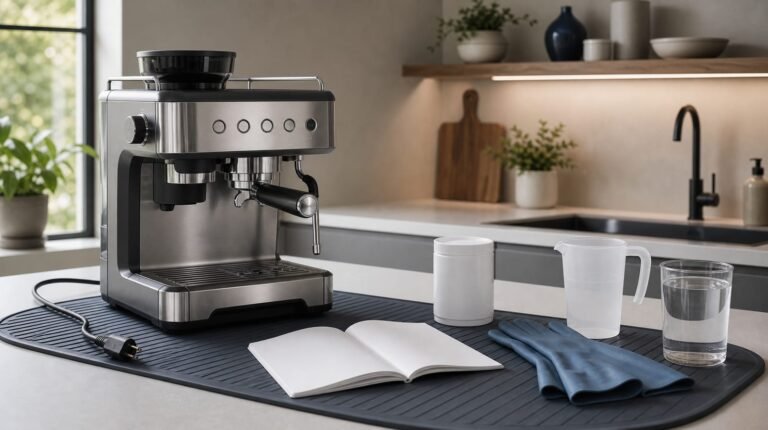
To descale a Nespresso machine with citric acid, two published guides use the same strength: one tablespoon of citric acid to every 500 ml of water. Nespresso’s VertuoPlus guide, however, names its own Descaling Kit and warns that vinegar or shop-bought descalers may damage the machine.
In practice the solution takes the place of the kit liquid: it goes into the tank, runs through your machine’s descaling programme, and is followed by plain water to flush the acid out, as The Kitchn’s method does. The controls for entering descaling mode still differ from one Nespresso model to the next.
That is a household recipe rather than a Nespresso instruction, and a spoon measures volume rather than weight. If your descaler’s label prints a dose in grams per litre, that dose is the more exact guide for the water your programme uses.
The lowest-risk choice is the Nespresso kit. If you still choose a citric-acid product, identify the exact model, check the label, then run the matching programme and rinse. This guide gives the full sequence for the VertuoPlus and for the Original Citiz.
This article was produced with the help of AI and reviewed before publication.
In this article
- Can you descale a Nespresso machine with citric acid?
- Check the product label and calculate only a stated dose
- Run the programme for your exact machine
- Set the next descaling reminder
- Choose the solution, dose and programme separately
Can you descale a Nespresso machine with citric acid?
Citric acid can dissolve mineral deposits in coffee makers, but that does not make household powder a manufacturer-backed choice for every Nespresso. Nespresso specifies its own descaling kit, while secondary guidance says household citric acid is not recommended for either Original or Vertuo machines.
If you go ahead with citric acid anyway, mix it at one tablespoon per 500 ml, pour that solution into the tank in place of the kit liquid and water, run your machine’s normal descaling programme, and flush with plain water afterwards. What changes is the risk, because that swap sits outside Nespresso’s instructions. To stay within them, use the kit and the procedure for your exact machine.
What descaling removes
Cleaning and descaling are different jobs. Cleaning deals with coffee oils and stains, whereas descaling removes crystallised mineral deposits attached to the brewer’s internal surfaces.
The main deposit is calcium carbonate from tap water. Water containing more dissolved minerals, including calcium, produces scale faster.
Scale can restrict water flow and alter the taste of the coffee. It can also narrow internal pipes, making the pump work harder, while deposits can reduce heat transfer and leave the drink lukewarm.
The difference matters because whatever goes into the tank travels the same path as your coffee. A cleaner for coffee oils on the outside of the machine is not a descaler, and a descaler is chosen for the mineral deposits inside it.
Nespresso’s recommendation and the citric-acid caveat
Nespresso says its machines should be treated with a Nespresso Descaling Kit. It describes the kit as containing a natural solution formulated to dissolve accumulated scale thoroughly.
A coffee-machine descaling guide published by Silvari Group, a third party rather than Nespresso, reports that Nespresso does not recommend household remedies such as citric acid for its Original and Vertuo machines. The same guide treats the instructions as specific to each machine family, generation and regional variant, even where two models look alike.
Some commercial coffee-machine descalers are based on citric acid, but that tells you nothing certain about Nespresso’s own liquid. Reports even disagree about its acid: one answer on a coffee forum says Nespresso tells customers to use only a lactic-acid solution or risk the guarantee, while a commenter in the same thread says Nespresso calls its descaler citric acid. With the formula unclear, there is no basis for reverse-engineering a homemade equivalent.
For the lowest-risk choice, use the Nespresso kit. If you use powdered citric acid, accept that it falls outside the stated recommendation for Original and Vertuo machines, and use either pure citric acid at the household ratio or a descaler at the strength its label prints. Do not treat an unlabelled powder, a blended descaling powder and pure citric acid as interchangeable.
Citric acid versus vinegar
Both citric acid and vinegar can remove scale from an ordinary coffee maker. Citric acid can bind with metals, while vinegar works through acetic acid.
Vinegar has two further drawbacks. It can soak into porous parts and leave coffee tasting of vinegar for weeks, and a wikiHow guide to descaling Vertuo machines, which is not a Nespresso document, warns that it may damage a Nespresso machine’s internal parts and hurt its performance.
Powdered citric acid avoids vinegar’s lingering taste, but it does not settle whether a product suits your machine. This guide treats a descaler as usable only when its packaging names the type of machine it is for, gives a dose for a coffee machine and the water to mix it with, and carries handling directions. A blended powder that gives none of the three leaves you guessing.
With that answer settled, the next two checks are the product label and the amount of water your machine’s cycle uses.
Check the product label and calculate only a stated dose
Reservoir size alone cannot determine a safe citric-acid dose. It becomes useful only when the product manufacturer states a concentration by mass, such as grams per litre, for coffee-machine descaling.
Reservoir-volume dose calculator
Let V be the water volume in litres that your machine’s descaling instructions give, and G the dose in grams per litre printed on the product label. The powder to weigh is V multiplied by G.
Citric-acid product dose (g) = water volume (L) × labelled dose (g/L)- Find the water volume specified for your machine’s descaling cycle. Use that working volume, rather than assuming the tank must be filled completely.
- Convert that volume from millilitres to litres by dividing it by 1,000.
- Find the product manufacturer’s stated coffee-machine dose in grams per litre. Do not substitute a spoon measurement or a dose intended for another purpose.
- Multiply the volume in litres by the labelled grams-per-litre figure.
- Weigh the calculated amount in grams. Use the product only if its label expressly covers your type of coffee machine and provides the necessary handling instructions.
Nespresso’s own instructions pair one branded unit or packet with a set amount of water: at least 500 ml (17 fl oz) with one unit of descaling liquid on the VertuoPlus, and 600 ml (20 fl oz) with one packet on the Vertuo Up. Those are water quantities for Nespresso’s liquid, not tested volumes for a homemade powder dose, so treat them only as a guide to how much water your machine’s cycle expects.
| Water your machine’s instructions give | In litres | Powder to weigh if the label states G g/L |
|---|---|---|
| 500 ml (VertuoPlus kit instructions) | 0.5 L | 0.5 × G grams |
| 600 ml (Vertuo Up kit instructions) | 0.6 L | 0.6 × G grams |
To see the arithmetic with a number: if a label stated 20 g per litre (a figure picked here only to illustrate, not a recommended dose), 0.5 litres of water would need 10 g. If the label gives a whole-batch amount instead, use that amount as printed rather than working backwards to a concentration.
Why descaling powder is not necessarily pure citric acid
One commercial coffee-machine descaler is described as citric-acid-based and as containing six treatments. Neither statement identifies the mass of citric acid in each treatment, so neither supports a homemade grams-per-litre conversion.
Similarly, Nespresso describes its kit as containing a natural scale-dissolving solution. Each unit is a measured liquid rather than a stated mass of acid, so it gives you no powder weight to reproduce.
Read the complete label rather than relying on the words “citric acid” on the front. You need a stated mass-based dose for coffee machines, not merely an ingredient name, packet count or number of advertised treatments.
When not to use a homemade mixture
Do not invent a grams-per-litre rate when the packet gives none, and do not guess what a scoop weighs. For pure citric acid with no label dose, use the household ratio of one tablespoon per 500 ml; for a blended powder that gives no dose at all, use the Nespresso kit instead.
Do not convert instructions for a pre-portioned liquid pouch into grams of household powder. A liquid quantity includes the whole formulation, and its volume does not establish how many grams of active acid it contains.
For an Original or Vertuo machine, Nespresso’s position is reason enough not to improvise. If you want a labelled descaler instead of the kit, check three things before buying: the label names coffee machines, ideally your type; it states a dose and the water to mix it with; and it carries safety directions. If any of the three is missing, or you cannot match the label to your model, use the Nespresso kit.
Treat any descaler as a chemical product. Nespresso warns that its solution may irritate skin and eyes, can discolour surfaces and must not be swallowed or left within children’s reach. If the powder label lacks comparable safety and application directions, do not use it in the machine.
In practice, a dose printed on the product’s own label always comes before any household ratio.
Once the solution and dose are settled, keep them separate from the controls and follow the complete sequence for your exact machine.
Run the programme for your exact machine
Button combinations, indicator lights and programme stages are not interchangeable between lookalike machines. A generic sequence risks starting the wrong function or leaving descaling mode active.
Identify the machine before starting
Confirm the full model name, then match it to the manufacturer’s instructions for your region; do not adapt a sequence because two machines look alike. The families differ in substance. The VertuoPlus enters descaling mode through a button-and-lever menu. Original machines such as the Citiz, Pixie and Inissia enter it when you hold both cup buttons for three seconds, and the U when you hold all three of its buttons for three seconds.
Two complete sequences follow, each from Nespresso’s own descaling guide for that machine: one for the VertuoPlus and one for the Original Citiz. Use the one that matches your machine, and only that one.
Follow one complete model-specific sequence
VertuoPlus sequence
- Switch on the VertuoPlus by pressing its main button.
- Raise the lever so the head opens and ejects any used capsule.
- Lower the lever to shut the head again.
- Turn the machine off by keeping the lever depressed for three seconds.
- Empty the cup support and used-capsule container.
- Pour one unit of Nespresso descaling liquid into the tank and add a minimum of 500 ml (17 fl oz) of water; do not top it up while the cycle runs.
- With the power off, depress the button and lever together for three seconds.
- Wait for an unbroken orange light, which confirms the special-functions menu is open.
- Push the lever down briefly once to select descaling mode.
- Check that the orange indicator now flashes once every two seconds.
- Place a container that holds at least 800 ml (27 fl oz) under the coffee outlet; a 1-litre jug leaves a margin.
- Start the programme with one brief press of the button.
- Let the machine discharge the mixture in intervals until it stops by itself.
- Empty the water tank and cup support after the descaling stage.
- Wash and rinse both parts thoroughly.
- Charge the tank with clean water.
- Begin rinsing with one brief press of the button.
- Leave the rinse to continue until the VertuoPlus stops automatically.
- Exit descaling mode by depressing the lever and button together for three seconds; release them when the light becomes green.
- Leave the machine unused for ten minutes.
- Wipe the machine with a damp cloth before returning it to service.

Original Citiz sequence
Nespresso’s Citiz guide puts the whole programme at 15 to 20 minutes. The descaling solution goes through the machine twice before the rinse.
- Switch the machine on and wait until the cup buttons stay steady.
- Eject the capsule and close the lever.
- Empty the capsule container, the water tray and the drip tray, then refit them.
- Put a receptacle under the coffee outlet.
- Fill the water tank halfway with water and add one packet of Nespresso descaling solution.
- Hold both cup buttons down together for three seconds. They blink quickly while descaling mode is on.
- Press and release the large cup button and let all of the solution run out through the coffee outlet.
- Pour the used solution back into the water tank.
- Empty the water tray and refit it.
- Put the empty receptacle back under the outlet and press the large cup button again to send the solution through a second time.
- Throw the solution away, rinse the tank well, fill it to the top with fresh water and fit it back on the machine.
- Empty the water tray again and refit it.
- With the empty receptacle under the outlet, press the large cup button so the whole tank of fresh water runs through.
- Hold both cup buttons for three to five seconds to leave descaling mode; the lights slow down or go steady.
- Take out the capsule container, the water tray and the drip tray, rinse each one under the tap, and fit them back on the machine.
- Refill the water tank and put it back on the machine.
- Wipe the machine with a damp cloth and leave it to rest for ten minutes before you use it.
Finish the specified rinsing and reset sequence
Do not treat the first automatic stop as the end of the job. On the VertuoPlus, the fresh-water rinse, the manual exit from descaling mode and the ten-minute rest all belong to the sequence. On the Citiz, the solution runs through twice, then a full tank of fresh water, and only then do you leave descaling mode and let the machine rest for ten minutes.
After completing the rinse and reset, record the job before returning the machine to routine use. A dual reminder provides a clear starting point for scheduling the next descale.
Set the next descaling reminder

Three months or 300 capsules
Nespresso’s VertuoPlus schedule has two limits: three months of elapsed time and 300 capsules used. Plan to descale as soon as you reach either one.
- Record the date you completed the descale, then set a calendar reminder for three months later.
- Start a separate capsule tally at zero and set its alert for 300 capsules.
- When the first reminder activates, descale the machine and restart both reminders.
For example, four capsules a day reach 300 in 75 days, so the capsule count comes first. At one capsule a day the count would take 300 days, so the three-month calendar reminder arrives long before it. Running both means you never have to predict how much you will use the machine.
Do not rely solely on the machine’s warning. On the VertuoPlus, a green-and-red light signals that descaling is due, and only several more coffees can be made before it becomes compulsory. Treat that alert as a final prompt rather than your main schedule.
How tap-water minerals create scale
When tap water is heated, its calcium and magnesium minerals can form scale. Those deposits can collect on heating elements, water lines and other internal components.
That gradual process explains why the reminder uses both time and capsule consumption. The calendar covers light or irregular use, while the capsule counter brings frequent users back to maintenance sooner.
Choose the solution, dose and programme separately
You can now make the decision in four stages.
- Use the Nespresso Descaling Kit for the lowest-risk route. Nespresso specifies this kit and warns that vinegar or shop-bought alternatives may damage the machine.
- If you still choose citric acid, use a coffee-machine product at the dose its label prints, or pure citric acid at one tablespoon per 500 ml of water, then flush with plain water.
- Identify the exact model and use its complete programme. Procedures differ between machine families, generations and regional variants, and the VertuoPlus and Citiz sequences differ from each other, so never move one machine’s steps to another.
- Set reminders for three months and 300 capsules after descaling, then act when the first limit is reached.
If you cannot find the correct sequence for your model, use the branded kit and its instructions rather than adapting another machine’s steps.
Sources
- Vertuo Plus Descaling Guide (PDF) — nespresso.com
- How to descale your capsule coffee machine: for consistent coffee flavor! How to Descale Capsule Machine… — opresso.com.hk
- The Easiest Way to Descale Your Coffee Maker Naturally, According to a Barista — thekitchn.com
- Lattissima Touch Descaling Guide (PDF) — nespresso.com
- Citric Acid Coffee Machine Descaling: Safe Model Guide — silvarigroup.com
- Nespresso descaling — hg.eu
- cleaning – Descaling Nespresso with citric acid — coffee.stackexchange.com
- How to Descale a Nespresso Vertuo: Complete Guide — wikihow.com
- Descaling – Nespresso® – Real Coffee — realcoffee.com
- Citiz Descaling Guide (PDF) — nespresso.com